intro to ASM: l9 bitwise shift
Shifting bits around in assembly is another interesting concept!
x86 allows you to 'shift' bits around in a register.
Take, for instance, al, the lowest 8 bits of rax.
The value in al (in bits) is:
rax = 10001010
If we shift once to the left using the shl instruction:
shl al, 1
The new value is:
al = 00010100
Everything shifted to the left and the highest bit fell off
while a new 0 was added to the right side.
You can use this to do special things to the bits you care about.
Shifting has the nice side affect of doing quick multiplication (by 2)
or division (by 2), and can also be used to compute modulo.
Here are the important instructions:
shl reg1, reg2 <=> Shift reg1 left by the amount in reg2
shr reg1, reg2 <=> Shift reg1 right by the amount in reg2
Note: 'reg2' can be replaced by a constant or memory location
Using only the following instructions:
mov, shr, shl
Please perform the following:
Set rax to the 5th least significant byte of rdi.
For example:
rdi = | B7 | B6 | B5 | B4 | B3 | B2 | B1 | B0 |
Set rax to the value of B4
We will now set the following in preparation for your code:
rdi = 0x7c1bb7d837750cd5
SOL:
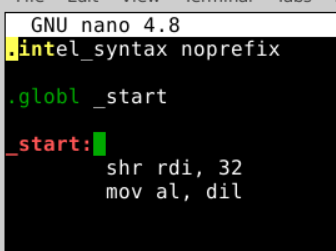
we have to shift rdi 4 bytes to the right which is 32 bits
therefore we first implement
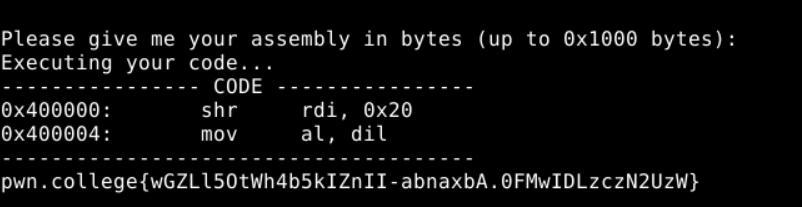
shr rdi, 32
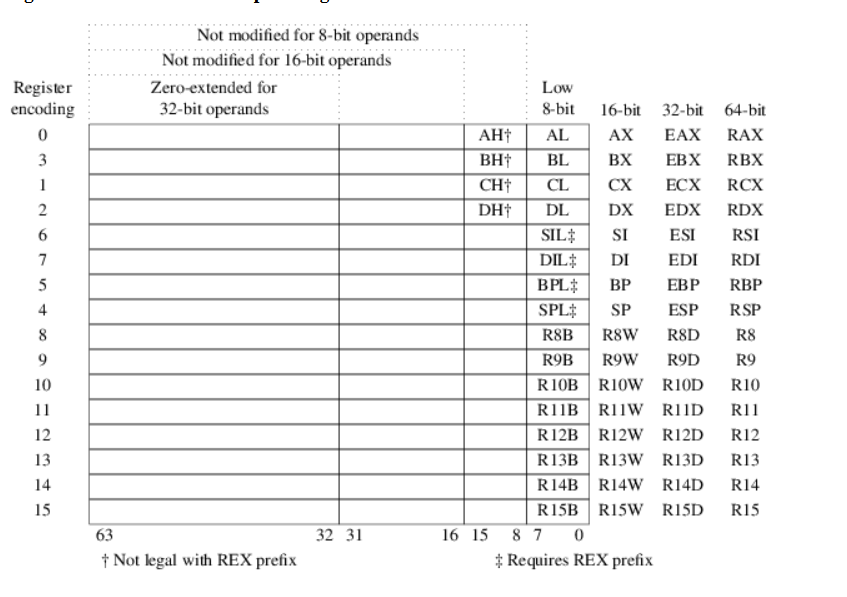
now we need to copy the lowest byte of rdi to rax. we therefore move dil (lower 8 bits of rdi) to al (lower 8 bits of rax)